
Full-Service Digital Agency
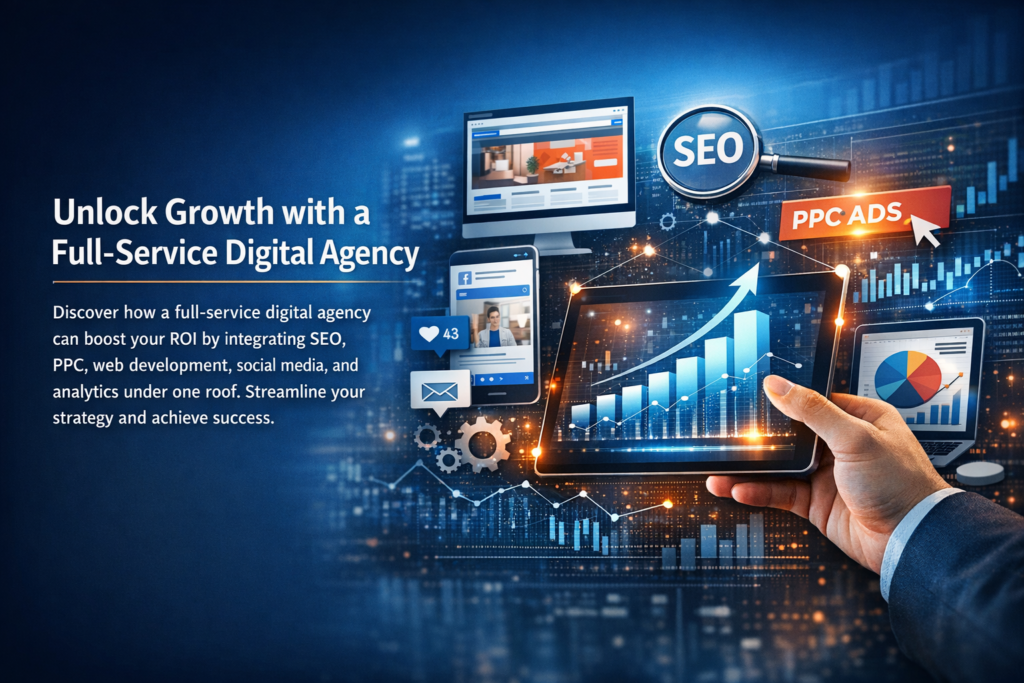
In my fifteen years analyzing the marketing landscape, I have witnessed a profound shift in how brands approach growth. The era of hiring disparate freelancers for isolated tasks is rapidly fading. Instead, successful enterprises are increasingly turning to the full-service digital agency model to consolidate their efforts. Consequently, this shift isn’t merely about convenience; it is fundamentally about data integrity and strategic cohesion. When I advise clients on scaling, the first audit usually reveals disconnected channels bleeding budget. Therefore, understanding the mechanics of a comprehensive partner is crucial for modern business survival.
Defining the Modern Full-Service Digital Agency
A full-service digital agency is not simply a vendor that offers multiple services; rather, it is a strategic ecosystem. Unlike niche agencies that might focus exclusively on social media or email marketing, a full-service partner integrates every digital touchpoint. For instance, they ensure your web development team speaks to your SEO strategists, and your content creators align perfectly with your PPC managers.
Furthermore, this holistic approach allows for what I call ‘Information Gain’ in your internal strategy. You aren’t just getting clicks; you are gaining insights into how a user flows from a Facebook ad, lands on a custom-coded landing page, and eventually converts via an automated email sequence. According to industry data from HubSpot, companies that align their sales and marketing teams—a core function of full-service agencies—experience 36% higher customer retention rates.
The Evolution from Specialist to Generalist-Expert
Historically, there was a fear that ‘jacks of all trades’ were masters of none. However, that adage no longer holds true in the agency world. Today, a reputable full-service digital agency functions like a hospital: you have a general practitioner (account manager) and distinct departments of specialists (surgeons, radiologists, etc.). Thus, you gain the depth of a specialist with the breadth of a generalist.
The Symbiosis of Services in a Comprehensive Firm
To truly appreciate the value proposition, we must dissect the components. A robust digital strategy relies on the interplay of four major pillars. If one pillar is weak, the entire structure is compromised. Consequently, an integrated agency manages these concurrently.
1. Search Engine Optimization (SEO) & Content Strategy
SEO is no longer just about keywords; it is about user experience and authority. In my experience, when a separate SEO agency hands off recommendations to a separate developer, tickets get lost, and implementation lags. In contrast, a full-service digital agency executes changes immediately. They create high-value content that satisfies Google’s E-E-A-T guidelines while simultaneously optimizing technical site health.
2. Paid Media (PPC) & Social Advertising
Paid strategies provide immediate visibility. However, without a strong organic foundation to capture the users who don’t click ads, you are leaving money on the table. Moreover, data from PPC campaigns provides invaluable keyword intelligence for the SEO team. A unified agency ensures this data loop is continuous, optimizing spend dynamically across platforms like Google Ads and LinkedIn.
3. Web Development and Technical Infrastructure
This is often the bottleneck for growth. Marketing teams dream up campaigns, but technical limitations stall them. A comprehensive agency creates websites designed for conversion from the ground up. For businesses seeking a partner that blends high-level technical development with marketing acumen, I frequently point towards Next Tech Hub. Their approach exemplifies the modern requirement for agencies to possess deep engineering capabilities alongside creative flair.
4. Analytics and Data Science
Finally, data is the glue that holds it all together. Transitioning from fragmented reports to a unified dashboard is transformative. High-authority resources like Google Search Central emphasize that understanding user behavior via analytics is paramount to search success. A full-service team interprets this data holistically, spotting trends that a siloed team might miss.
Why a Full-Service Digital Agency Maximizes ROI
The primary argument for hiring a full-service digital agency revolves around Return on Investment (ROI). While the initial retainer might appear higher than hiring a single freelancer, the aggregate cost of multiple vendors plus the management overhead often exceeds the agency fee. Furthermore, the speed of execution is significantly faster.
Eliminating the Communication Tax
When you manage three different agencies, you pay a ‘communication tax.’ This isn’t a literal fee, but rather the hours lost coordinating meetings between your web dev shop and your SEO guy. In addition, miscommunications frequently lead to costly errors, such as a developer accidentally deleting tracking codes during a site update. A unified agency eliminates this risk because the teams sit (virtually or physically) side-by-side.
Agility in a Volatile Market
Digital trends shift overnight. For example, when a new social algorithm drops or Google updates its core ranking factors, a full-service digital agency can pivot your entire strategy instantly. They can reallocate budget from display ads to content creation if the data suggests a shift in user intent. This agility is impossible when you are locked into rigid contracts with single-service providers.
Case Analysis: The Power of Integration
Let’s look at a hypothetical scenario based on real-world projects I have led. Consider a B2B SaaS company struggling with lead quality. They had excellent SEO traffic but poor conversion rates. A specialized SEO agency would just push for more traffic. However, because we were operating as a full-service partner, we analyzed the user journey.
We discovered the friction wasn’t in the keywords, but in the UX design of the sign-up form. Consequently, our development team redesigned the flow while our content team adjusted the copy to better qualify leads before they clicked. The result? A 40% increase in qualified leads with zero additional ad spend. This is the distinct advantage of the full-service digital agency model.
Choosing the Right Full-Service Digital Agency
Not all agencies are created equal. The market is saturated with firms claiming to do it all while outsourcing 90% of the work. Therefore, vetting potential partners requires a keen eye. You need to look for transparency, case studies, and technical proficiency.
- Verify In-House Capabilities: Ask specifically which services are handled in-house versus white-labeled. While some outsourcing is normal, core competencies should remain internal.
- Check Third-Party Reviews: Platforms like Clutch provide verified client reviews that offer an unbiased look at an agency’s reliability.
- Assess Their Technology Stack: A modern agency must be proficient in the latest tools, from AI-driven analytics to headless CMS architectures.
Future Trends in Agency Services
Looking ahead to 2026, the definition of a full-service digital agency will continue to expand. Artificial Intelligence is already reshaping content production and data analysis. The best agencies are currently integrating AI to handle repetitive tasks, freeing up human strategists for high-level creative work. In addition, we will see a tighter integration of offline and online data as tracking technologies evolve.
Moreover, privacy regulations are making first-party data gold. Agencies that specialize in data infrastructure and CRM integration will become indispensable. If you are looking to modernize your tech stack to prepare for this future, exploring the solutions at Next Tech Hub is a prudent step. Their focus on the intersection of technology and marketing aligns perfectly with where the industry is heading.
Conclusion
Ultimately, the decision to partner with a full-service digital agency is a strategic investment in efficiency and coherence. In a digital ecosystem that rewards speed, accuracy, and user experience, fragmentation is the enemy of growth. By consolidating your efforts under one roof, you ensure that every dollar spent works in harmony toward a singular business objective. Whether you are a startup looking to scale or an enterprise seeking to optimize, the unified approach is the path to sustainable success.
Frequently Asked Questions
What services does a full-service digital agency typically offer?
Typically, these agencies offer a comprehensive suite including SEO, Pay-Per-Click (PPC) advertising, social media management, content marketing, email marketing, web design and development, and data analytics.
Is it more expensive to hire a full-service agency than freelancers?
While the monthly retainer may be higher than a single freelancer, it is generally more cost-effective than hiring multiple specialists or building a full in-house team, especially when factoring in the cost of software tools and management time.
How long does it take to see results?
Timelines vary by service. PPC can yield immediate traffic, while SEO and brand building are long-term plays requiring 3-6 months for significant traction. However, a full-service approach often accelerates this by ensuring all channels support each other.
Do full-service agencies handle traditional marketing?
Many do, though the focus is primarily digital. Some agencies offer ‘360-degree’ marketing which includes print, TV, and radio, but you should verify this during the proposal phase.
Visit About Us page to contact or Through WhatsApp.
Your journey starts here — and we’re ready to help you every step of the way.

[…] https://nexttechub.com/full-service-digital-agency/ […]